10 LinkedIn New Job Announcement Templates (That Don't Sound Like Everyone Else's)

A new job announcement is the highest-reach post most people will ever write. LinkedIn pushes job changes hard, your entire network has a reason to react, and even dormant connections surface to say congrats. It's the one post where distribution is basically free.
And most people waste it on "I'm thrilled to announce that I'm beyond excited…"
The templates below are built to do more with that free reach: tell a story worth reading, thank people specifically, and convert the attention into followers who'll still be there for your next post. Ten of them, organized by situation — first job, promotion, career change, going solo, and more — each with a copy-paste skeleton, and filled-in examples where it helps.
The anatomy of a job announcement that gets read
Every strong announcement hits five beats, in roughly this order:
- Hook — one line that isn't "I'm excited to announce." A feeling, a story beat, or a surprising word.
- The news — role and company, plainly. Don't bury it past line two.
- The why — what the company does and why this problem pulled you in. This is the part everyone skips, and the part that makes people follow you.
- The gratitude — thank one or two people for specific things, not "everyone for the support."
- The door — an open invitation: what you'll post about, who should reach out, what you're looking to learn.
When to post it
Three workable windows, each with a different upside:
- Day one — maximum excitement, but you know nothing yet. Fine for most roles.
- End of week two — you can write about the team and the work with actual texture. Usually the best choice.
- After your first win — "three months in, we just shipped X" positions you as someone who delivers, not just someone who got hired.
The only hard rule: never announce before everything is signed and finalized. Offers fall through, and unt-announcing is a special kind of pain.
The templates
1. The Classic (works for any role)
[One honest line about how this feels — not "excited to announce"].

I'm joining [Company] as [Role].

[What the company does, in one line a stranger understands.]

[The specific problem you'll work on — the part that made you say yes.]

Thank you to [one or two people] for [the specific thing they did].

And to the [Previous Company] team: [one genuine sentence about what they taught you].

First priority: [one concrete goal].

If you work on [problem space], my DMs are open.
Terrified-in-a-good-way is closer to the truth than "thrilled." I'm joining Meridian as Head of Data. They help hospitals predict bed shortages 48 hours out — in a bad winter, that's the difference between a hallway bed and an ICU bed. I'll be building the forecasting team, the exact problem I couldn't stop thinking about after a family member spent a night in an ER hallway. Thank you to Priya for the referral she didn't have to make, and to the Loopwell team for teaching me that a data team is a service function, not a priesthood. First priority: hire two engineers better than me. If you work on healthcare forecasting, my DMs are open.
Why it works: a specific why beats the corporate default, and one concrete first priority signals competence to every future employer, client, and hire reading it.
2. The First Job Out of College
[Timeframe] ago, I [the moment you chose this path].

[One or two lines about what it actually took — applications, rejections, side projects.]

Today I start as [Role] at [Company].

To everyone who [specific help — reviewed my portfolio, took my calls, sent me postings]: thank you.

Three things I'm bringing with me:
→ [Skill or trait]
→ [Skill or trait]
→ [Skill or trait]

And one thing I'm here to learn: [the honest gap].

If you're a [role] at [Company] or in [industry], I'd love to connect.
Why it works: humility plus specificity reads as self-awareness, and "one thing I'm here to learn" invites seniors to help — which is how first jobs turn into careers.
3. The Promotion (internal move)
[Number] years ago I joined [Company] as [old role].

[One line about the early days — a detail only insiders would know.]

This week I stepped into a new role: [new title].

What changes: [the new scope, in one line].
What doesn't: [the mission/value you still care about].

Thank you to [manager/mentor] for [the specific thing they trusted you with before you were ready].

To the team: [one sentence about what you'll do for them in the new seat].
Why it works: internal announcements are read mostly by colleagues — the "what I'll do for you" line is the beat that turns congratulations into confidence.
4. The Career Change
After [timeframe] in [old field], I'm making the jump to [new field].

Today I start as [Role] at [Company].

People keep asking why. The honest answer:

[Two or three lines — the real reason, not the polished one.]

What I'm bringing from [old field]:
→ [Transferable skill, translated into the new context]
→ [Transferable skill]

What I'm leaving behind: [one light, self-aware line].

To everyone who told me it was too late to switch: [gracious, not smug — one line].
After 8 years in teaching, I'm making the jump to UX design. Today I start as a Junior UX Designer at Calyx. People keep asking why. The honest answer: I spent a decade explaining complicated things to overwhelmed people, and one day I realized that's a job description — just not the one I had. What I'm bringing from the classroom: → Translating complexity into something a tired person can absorb → Reading a room (a failing onboarding flow is just a confused classroom) What I'm leaving behind: grading on weekends. To everyone who said 34 was too late to start over: thanks for asking good questions instead of nodding politely.
Why it works: reframing the old career as the qualification for the new one is the whole game in a career-change announcement.
5. Going Solo / Starting a Company
[Timeframe] ago, [the moment the idea started — be specific].

Today it's official: I left [Company/role] to build [Company/venture].

What we're building: [one line, plain words — what it does and for whom].

Why now: [the change in the world or in you that makes this the moment].

Thank you to [previous employer/team] — [one genuine sentence].

What happens next here: I'll be posting [what you'll share — the build, the mistakes, the numbers] every [cadence].

If you're [target customer/advisor/potential hire], I want to hear from you.
Why it works: "what happens next here" converts announcement traffic into followers — the whole point of posting it.
6. The Return After a Break
After [timeframe] away — [parental leave / sabbatical / caring for family / health] — I'm back.

Today I start as [Role] at [Company].

[One honest line about the break — what it gave you, not what it cost.]

Thank you to [Company] for [the specific flexibility or welcome they offered].

And to everyone who kept in touch while I was gone: [one line — you know who you are].

Ready when you are, [industry/problem].
Why it works: normalizing the gap is a service to everyone watching who'll need one someday — those readers remember who said it out loud.
7. The Relocation
New city, new role.

This week I moved to [City] to join [Company] as [Role].

[One line about why the move — the company, the market, the life.]

Things I already know I'll miss about [old city]: [one specific, human detail].
Things I'm looking forward to: [one specific, human detail].

[City] network: who's got the best [coffee / running route / coworking spot]? Taking recommendations and introductions.
Why it works: asking for local recommendations gives hundreds of people a zero-effort way to engage — and relocations live or die on rebuilt networks.
8. After a Layoff
[Timeframe] ago, my role at [Company] was eliminated.

[One or two honest lines about that period — no bitterness, no toxic positivity.]

Today I start as [Role] at [Company]. [One line about why this one is right.]

Thank you to the people who made introductions, sent postings, and checked in — especially [name] and [name].

If you're in that in-between right now: my DMs are open. Happy to do for you what they did for me.
Why it works: layoff-to-landing posts get enormous engagement because they give people hope with a roadmap attached. Offering to pay it forward multiplies the goodwill.
9. The Short & Confident (for senior roles)
[New title] at [Company].

[One line on the mission you'll own.]

[One line of thanks, or one line on what's next.]

That's the post.
VP of Engineering at Northbeam. Owning the platform team as we scale from 40 to 100 engineers. Grateful to everyone who bet on me along the way. Time to build. That's the post.
Why it works: at senior levels, brevity is the flex. The "That's the post" kicker has become a format of its own precisely because it signals confidence.
10. The Client-Facing Role (consultants, agencies, sales)
New role, same mission: [the outcome you deliver].

I've joined [Company] as [Role], where I'll be helping [client type] [specific outcome].

[One line on why this company — the thing they do differently.]

To my [Previous Company] clients and colleagues: thank you for [specific thing]. [One line on continuity — where they can find you.]

If you're a [client type] working on [problem], let's talk — first coffee's on me.
Why it works: your network is your book of business — this version treats the announcement as what it is, a soft launch to future clients.
Mistakes that waste your biggest post
- "I'm thrilled to announce that I'm beyond excited…" — the single most-scrolled-past opening on LinkedIn. Start with a feeling that has texture, or skip the feeling and start with the news.
- Burying the news in paragraph three. Role and company belong in the first two lines, before the "…see more" fold.
- Thanking "everyone" for "everything." Generic gratitude reads as no gratitude. One name plus one specific act beats a paragraph of acknowledgments.
- Trash-talking the old job, even subtly. Everyone reading is mentally filing you under "how they left the last place." Praise specifically or say nothing.
- Announcing before it's final. Signed, confirmed, start date set — then post.
- Posting and vanishing. A job announcement pulls hundreds of comments, and each of your replies bumps the post back into feeds. Block the evening. Reply to everyone.
- Forgetting the rest of your profile. Half your congratulators will click through to your profile. If your headline still says the old job, you've wasted the traffic — fix the headline first.
After the announcement
The announcement is day one of your presence at the new company, not a one-off. The people who followed you for the news will watch what you post next — share what you're learning in the role, the problems you're working on, the industry from the inside. That's how one big post becomes an audience.
If posting consistently is the part you know you'll drop, that's literally what inHype is for: it drafts posts in your voice every morning, you approve in a tap, and your new network keeps hearing from you long after the congratulations fade. And when you need formats, the 15 LinkedIn post templates library has a milestone and an announcement skeleton ready to go.
Put this into practice on LinkedIn
inHype turns your expertise into scroll-stopping LinkedIn posts — hooks, drafts, scheduling and analytics in one place.
Get started freeRead more
15 LinkedIn Post Templates That Actually Get Engagement (Copy & Paste)
15 proven LinkedIn post templates with blank skeletons and filled-in examples — for storytelling, teaching, authority, engagement, and announcements.
30 LinkedIn Headline Examples That Get You Clicked (With Templates)
30 LinkedIn headline examples for founders, job seekers, freelancers, and sales — plus the 4-part formula, fill-in templates, and before/after rewrites.
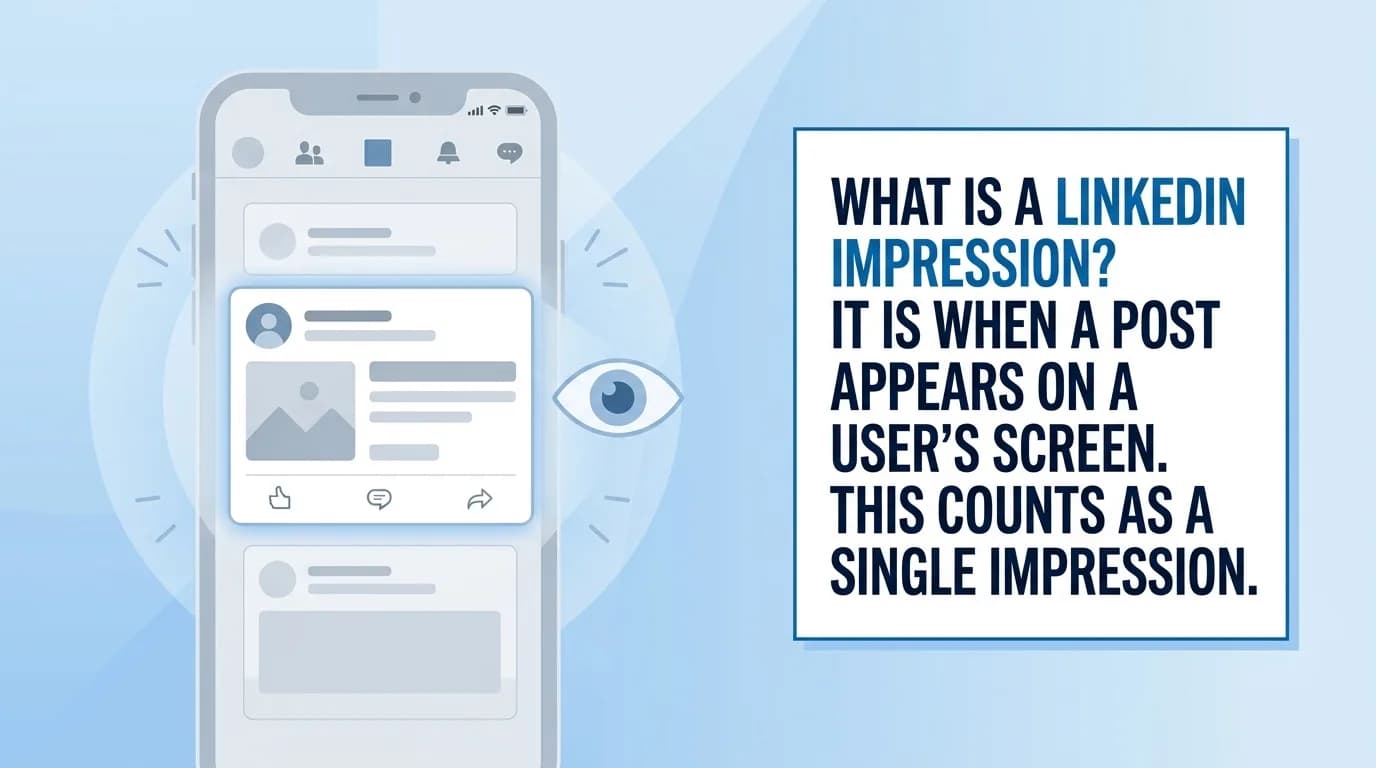
What Is a LinkedIn Impression? (And Why Yours Dropped)
What LinkedIn impressions actually count, impressions vs. reach vs. views, what a good number looks like, why yours dropped, and 7 ways to get more.